About The Final Countdown
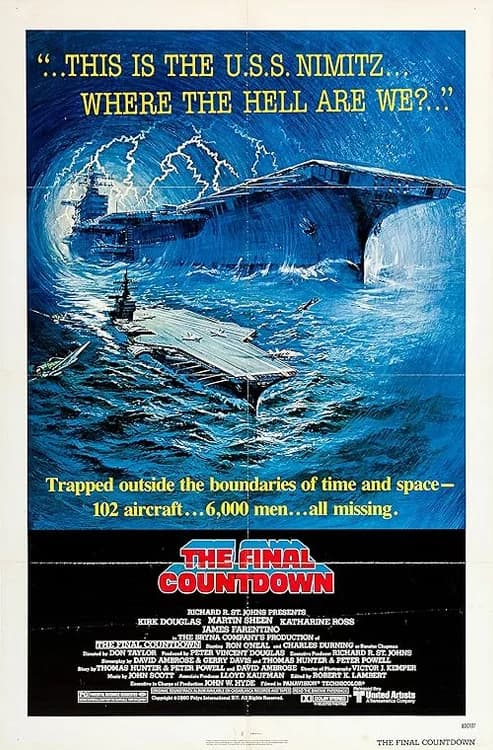
The Final Countdown (1980) presents one of cinema's most compelling military science fiction premises: the USS Nimitz, a state-of-the-art nuclear aircraft carrier, encounters a mysterious storm that transports it back to December 6, 1941—just one day before the devastating Japanese attack on Pearl Harbor. Directed by Don Taylor, this imaginative thriller explores profound questions about historical intervention as Captain Matthew Yelland (Kirk Douglas) and systems analyst Warren Lasky (Martin Sheen) grapple with whether to use their advanced technology to alter the course of World War II.
The film excels in its authentic naval atmosphere, featuring remarkable real aircraft carrier footage and impressive flight sequences that showcase F-14 Tomcats against vintage Japanese Zeroes. Douglas delivers a commanding performance as the conflicted captain, while Sheen provides thoughtful counterpoint as the civilian analyst questioning the ethics of temporal interference. The tension builds steadily as the crew discovers their predicament and debates their responsibility toward history.
What makes The Final Countdown particularly engaging is its intelligent approach to time travel paradoxes combined with genuine military authenticity. The production secured unprecedented access to actual naval operations, giving the film a documentary-like realism that enhances its speculative narrative. For viewers interested in alternative history scenarios, naval warfare, or thoughtful science fiction, this film offers a unique blend of action, ethical dilemmas, and historical what-ifs that remains compelling decades after its release. The Final Countdown stands as a distinctive entry in 1980s cinema that continues to spark discussion about fate, technology, and historical destiny.
The film excels in its authentic naval atmosphere, featuring remarkable real aircraft carrier footage and impressive flight sequences that showcase F-14 Tomcats against vintage Japanese Zeroes. Douglas delivers a commanding performance as the conflicted captain, while Sheen provides thoughtful counterpoint as the civilian analyst questioning the ethics of temporal interference. The tension builds steadily as the crew discovers their predicament and debates their responsibility toward history.
What makes The Final Countdown particularly engaging is its intelligent approach to time travel paradoxes combined with genuine military authenticity. The production secured unprecedented access to actual naval operations, giving the film a documentary-like realism that enhances its speculative narrative. For viewers interested in alternative history scenarios, naval warfare, or thoughtful science fiction, this film offers a unique blend of action, ethical dilemmas, and historical what-ifs that remains compelling decades after its release. The Final Countdown stands as a distinctive entry in 1980s cinema that continues to spark discussion about fate, technology, and historical destiny.